
Bevel cut
Bevel cuts are used in sheet metal design to create parts that are easier to weld. Beveled edges increase the weld surface area, leading to stronger welds. Welding on beveled edges can also help improve the aesthetics of weld edges by concealing the weld lines.
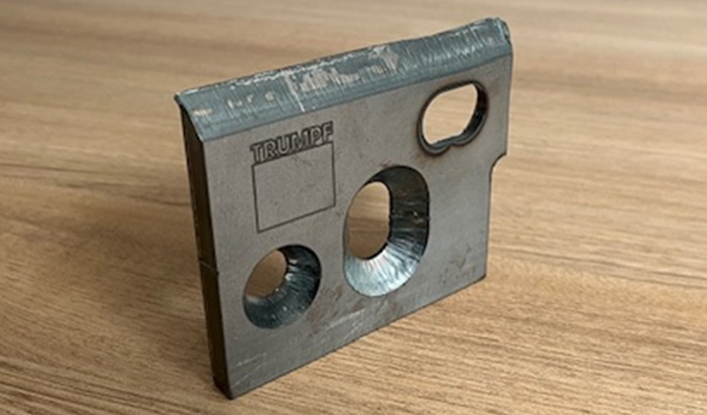
Flux supports four different types of bevel profiles:

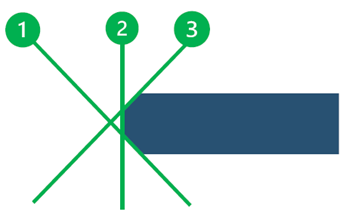
These profiles are achieved by using up to three cuts along any edge of the contour. The image below shows these three cuts, in the order in which they will be processed.
-
Bottom Chamfer Cut
-
Vertical Cut
-
Top Chamfer Cut
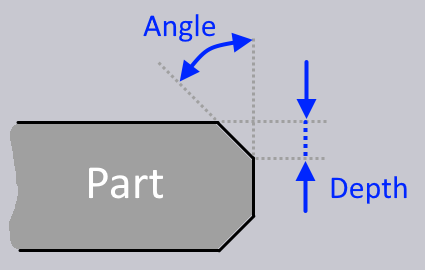
Different bevel profiles will require different combinations of these cuts. For example, the Y-Bevel type will require the vertical cut, and the top chamfer cut, while the DY-Bevel type will require all three. The chamfers are defined using the chamfer angle, and the chamfer depth. Here is the how they are defined for the top chamfer. The bottom chamfer is defined similarly.
Creating bevel cuts
Bevel cutting is enabled for parts if these conditions are met:
-
Select a TruLaser machine that can tilt the cutting head for bevel cutting.
-
Use a sheet with thickness greater than or equal to 3 mm.
-
Select an LTT (Laser Technology Table) that includes the bevel-cut process type.
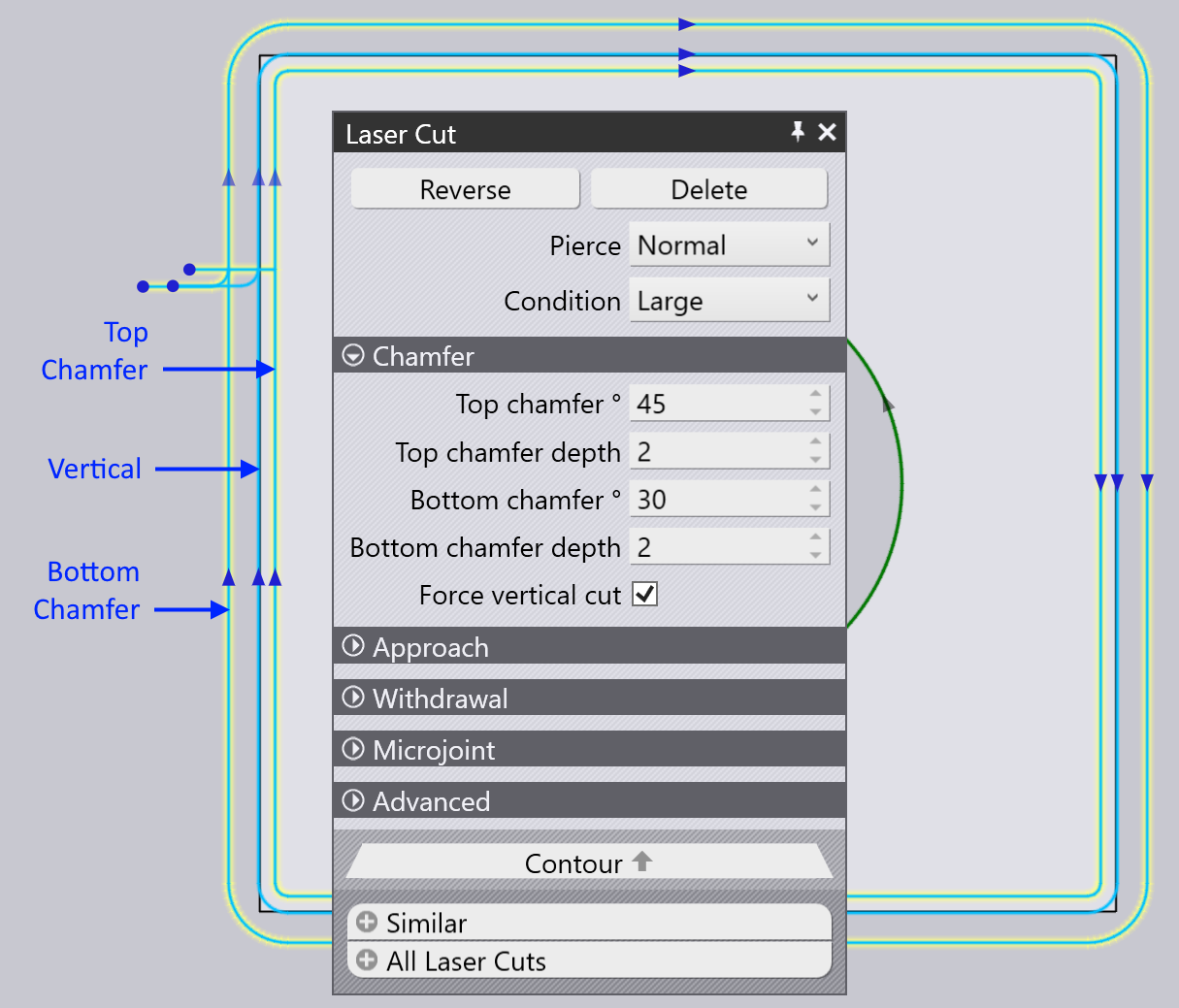
With all these conditions met, the Laser Cut panel has a Chamfer section where Bevel cutting can be programmed.
-
Top chamfer ° and Top chamfer depth must both be non-zero to create a chamfer cut at the top.
-
Bottom chamfer ° and Bottom chamfer depth must both be set non-zero to create a chamfer cut at the bottom.
-
If the sum of the two chamfer depths is the same as the sheet thickness, then the chamfer(s) effectively define the outer boundary of the part, and the vertical cut shown in the image above is not really necessary. However, a cleaner edge is sometimes obtained with a vertical cut, and you can select the Force vertical cut checkbox to turn it on.
The laser cutting line is projected to the top surface of the part and shown on the part. The bevel cut paths are shown with a yellow highlight around them, and all the three parts are tagged in the image above.